
Many owners are now looking at solar as a way to push back against rising utility costs. Done right, a solar panel system can reduce how much electricity you buy from the grid, stabilize long-term energy spending, and support sustainability goals your customers notice. Paired with battery storage, it can also keep select equipment running when the power drops.
This article walks through how restaurant solar systems get designed, what they actually cost, which incentives apply right now, and the practical hurdles — leases, permitting, cash flow — that come with getting a project built.
Key Takeaways
- Energy bills, hourly usage patterns, roof or land availability, and utility rate structure determine solar fit, not restaurant size alone.
- Grid-tied solar, solar-plus-storage, canopies, ground mounts, and community solar suit different properties and goals.
- A credible financial model uses current installed pricing, utility charges, incentives, and financing terms instead of a generic national payback number.
- Battery storage protects selected critical loads, such as refrigeration and POS systems, not every appliance in the building.
Why Restaurants Are Strong Candidates for Solar
The Restaurant Energy Profile
Refrigeration, freezers, ice machines, HVAC, exhaust ventilation, lighting, dishwashing, cooking equipment, water heating, and digital systems all stack up fast. Food-service electricity intensity averages 43.8 kWh per square foot annually, according to EIA's 2018 CBECS data, among the highest of any commercial building type.
Electric cooking, refrigeration, cooling, heating, and ventilation each contribute to that total, but they're not simply additive percentages of one bill. Two things matter for sizing a system:
- Consumption — total kWh used over time, which solar offsets
- Demand — your peak kW draw, which many utilities bill separately
Some utilities calculate demand charges from the highest usage recorded in a 10- to 20-minute window during the month. A single lunch-rush spike from ovens, fryers, and HVAC running together can set that charge for the entire billing cycle.
Matching Solar Production to Your Hours
Lunch-focused restaurants have an advantage: daytime prep, service, and refrigeration overlap with peak solar output, so a meaningful share of generation gets used as it's produced.
Dinner-heavy operations face a mismatch. Solar tapers off right as the evening rush begins. The practical response is to pair solar with:
- Battery storage that charges midday and discharges during dinner
- Time-of-use rate awareness to shift flexible loads when possible
- Realistic expectations about how much of the bill solar alone will offset
Business Benefits Beyond the Utility Bill
Reducing grid purchases is the headline benefit, but it's not the only one. Properly maintained solar equipment has a long operating life, giving owners decades of predictable production and some insulation from utility rate hikes.
Sustainability messaging can also matter to customers, though it's worth verifying with your own market research rather than assuming a direct sales bump. Environmental branding resonates differently across customer segments, so treat it as a complement to savings, not the main justification.
Outage Risk: What Solar Can (and Can't) Do
This trips up a lot of owners. Standard grid-tied inverters are required under UL 1741 to shut down during a grid outage (a safety measure that also means your panels stop producing when you need backup power most), according to DOE's resilience basics.

A properly configured battery and transfer equipment changes that picture by supporting designated circuits. Before assuming coverage, evaluate:
- Refrigeration and freezer monitoring
- Security systems and internet connectivity
- POS and payment processing
- Emergency lighting and selected kitchen equipment
Is Your Property a Good Fit?
Feasibility depends on several site factors:
- Roof orientation, shading, age, and structural capacity
- Available roof or ground area and electrical service capacity
- Parking lots, adjacent land, and local permitting
A professional site assessment should verify these conditions before anyone relies on projected production or savings numbers.
Designing a Solar Panel System for a Restaurant
Start With an Energy and Property Assessment
A proper design starts with data, not a rooftop sketch. Installers should review several months (ideally 12 or more) of utility bills, interval usage data where available, operating schedules, demand charges, seasonal swings, and any planned equipment upgrades.
Equally important: inspecting roof condition, structural capacity, shading, electrical infrastructure, and fire-access requirements. If the roof needs replacing in the next few years, that conversation happens before installation, not after.
Compare System Configurations
| Configuration | Best for | Key consideration |
|---|---|---|
| Grid-tied | Bill reduction only | Depends on utility grid; verify interconnection and export-credit rules |
| Hybrid (solar + battery) | Backup, demand management | Requires battery, suitable inverter, and islanding controls |
| Off-grid | Remote or unusual properties | No utility connection; needs careful load and storage planning |
Match System Design to Restaurant Loads
Offsetting your annual electricity use is a different design problem than building a critical-load panel for outages. A designer accounting for restaurant-specific demands needs to factor in:
- Motor-starting loads from compressors and refrigeration cycling
- HVAC startup surges
- Cooking and ventilation equipment draw
- Future electrification, such as heat pumps or EV charging infrastructure
When Roof Space Runs Out
A cramped or obstructed roof doesn't rule out solar. Options include high-efficiency modules that produce more per square foot, solar carports over parking areas, ground-mounted arrays, and community solar subscriptions for properties where onsite generation isn't practical.
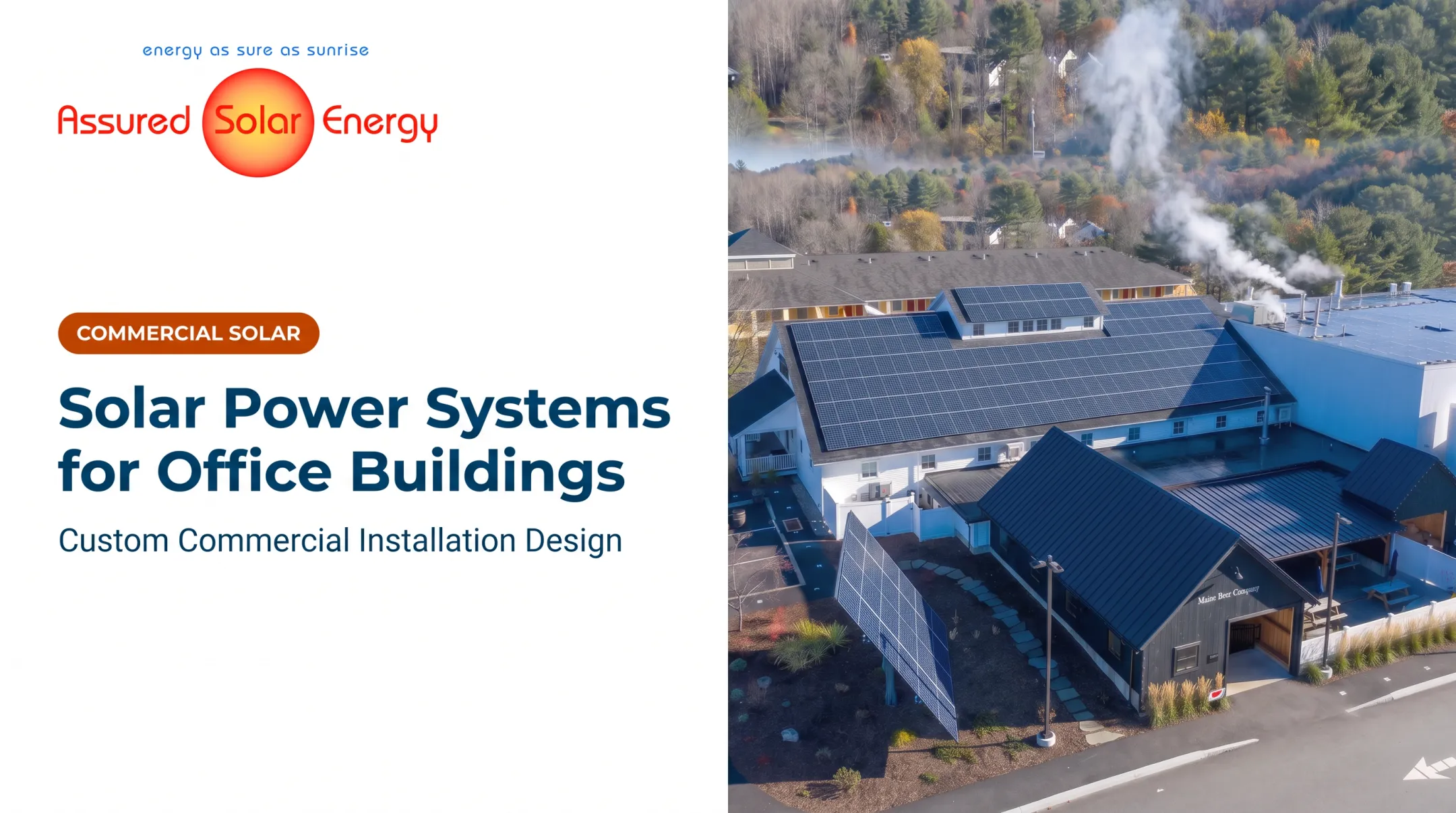
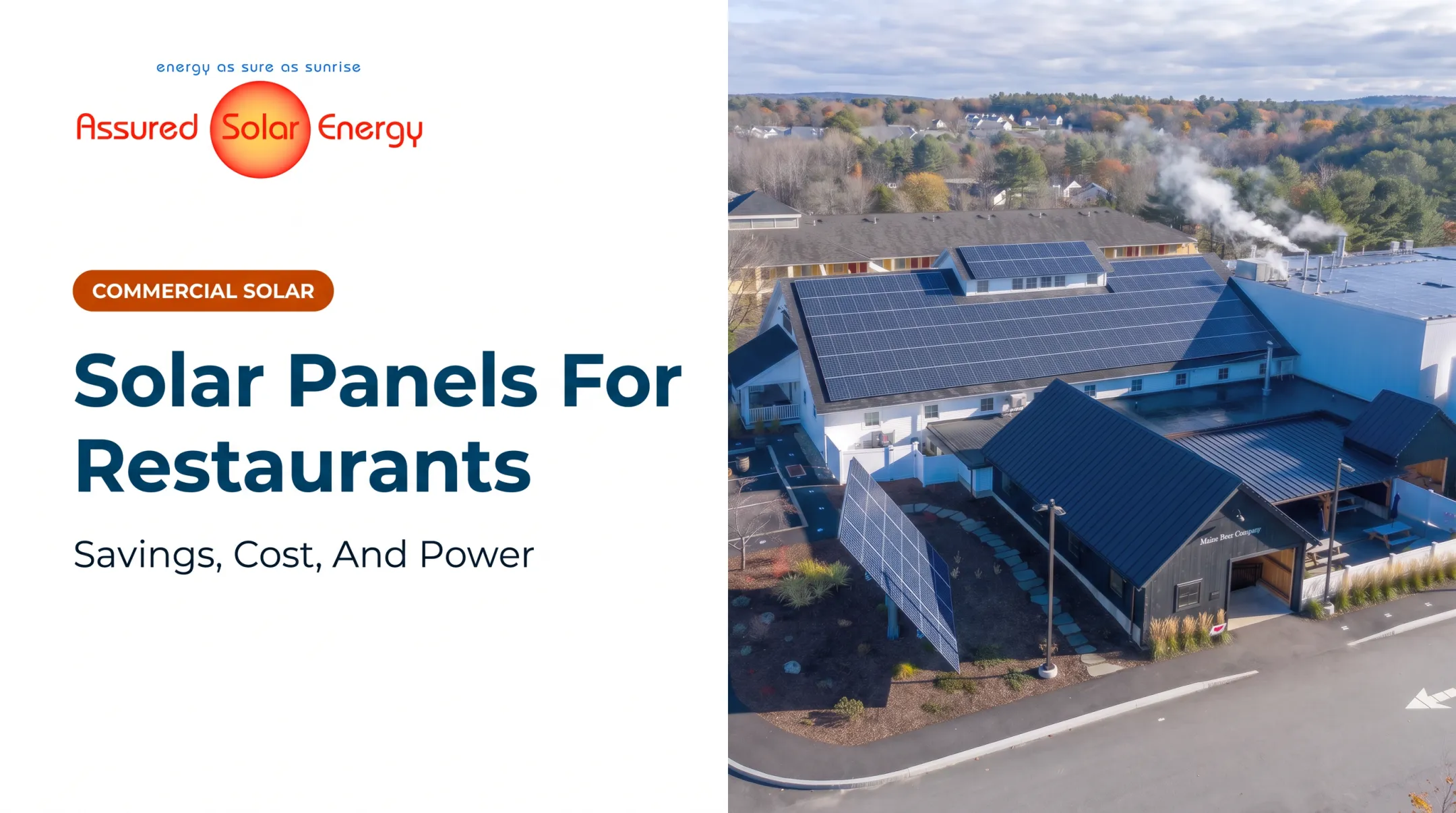
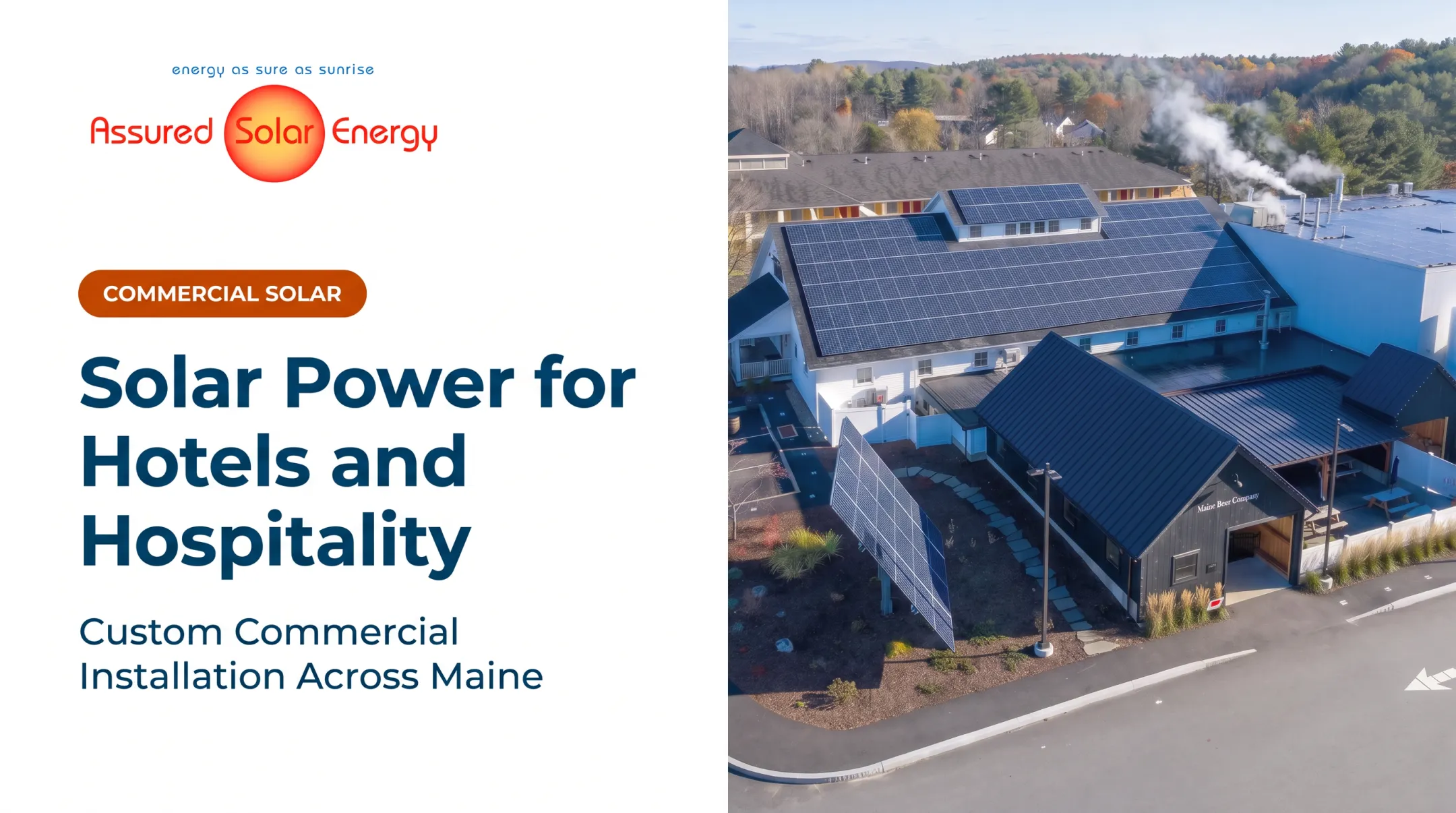
Maine Beer Company's facility illustrates this well: it combines extensive rooftop arrays with a ground-mounted array beside the building, splitting generation across available space rather than forcing everything onto the roof. Each alternative carries trade-offs around cost, permitting, construction, and (for leased sites) landlord approval.

How Assured Solar Energy Approaches Restaurant Projects
For restaurants in Midcoast and Southern Maine, Assured Solar Energy designs grid-tied, off-grid, and battery-backed commercial systems using LIDAR-based site modeling. The company handles the full project arc (design, engineering, permitting, procurement, installation, activation, and compliance documentation) so owners aren't juggling multiple contractors for one roof.
Restaurant Solar Costs, Incentives, and Financial Planning
What Drives Commercial Solar Cost
Commercial solar pricing depends on several site and equipment factors:
- System capacity and panel/inverter selection
- Battery size and mounting method
- Roof or structural work, trenching, and electrical upgrades
- Interconnection, permitting, and overall site complexity
NREL's 2024 ATB models a 200 kWdc flat-roof commercial system at $1.78 per watt DC. That figure is a useful benchmark, though it excludes regional cost variation and isn't a restaurant-specific quote.
Answering the "Average Cost" Question
"Average cost of a commercial solar panel" can mean three different things: a single module, a fully installed system, or a price per watt. Before trusting any number, confirm which one it refers to.
In one recent Assured Solar commercial project, a $200,000 system required a $10,000 payment to secure full federal incentives under current safe-harbor rules. Every quote will vary by system size, roof conditions, storage inclusion, labor, and local utility requirements.
Ownership and Financing Options
| Structure | Who owns equipment | Payment | Who gets tax benefits |
|---|---|---|---|
| Cash purchase | Restaurant | Upfront | Restaurant |
| Commercial loan | Restaurant | Monthly payments | Restaurant |
| Lease | Third party | Fixed lease fee | Third party |
| PPA | Third party | Price per kWh generated | Third party |
An interest-free, "same-as-cash" loan structure (for example, $28,000 financed at $233 per month over 120 months with a small initial cash outlay) is one financing path Assured Solar has arranged for similar projects. Lease and PPA terms need careful review of escalators and transfer provisions if the business relocates.
Incentives and Tax Treatment in 2025
Federal and state incentives change frequently, so verify current rules before finalizing a budget:
- A 30% federal Investment Tax Credit applies to qualifying commercial projects placed in service by December 31, 2027
- Construction must generally begin before July 4, 2026, for full credit eligibility; a down payment of at least 5% before year-end can help safe-harbor a project under 2025 rules
- Maine's renewable energy equipment property-tax exemption requires an application completed by April 1 of the relevant year
- Battery storage, depreciation rules, and bonus qualifications depend on project specifics; have a tax professional confirm eligibility
Build a Site-Specific Financial Model
Skip the generic payback estimate. A credible model compares annual savings, demand-charge effects, battery value, maintenance, financing costs, degradation, and incentives under conservative, expected, and high-production scenarios.
In one documented Assured Solar project, year-one utility savings of roughly $3,700 more than covered loan payments, producing positive cash flow within the first year. That result is specific to that site, not a universal guarantee.

Challenges and Practical Solutions
Upfront cost and cash flow. Ownership requires more capital upfront but captures incentives directly. Third-party financing lowers the barrier to entry but shifts long-term savings and tax benefits elsewhere. Compare financing terms and actual savings together, not in isolation.
Leased properties. Installing solar on a leased building means negotiating:
- Landlord consent and roof-control provisions
- Lease duration relative to system payback period
- Equipment ownership and removal obligations
- Transfer terms if the business relocates
Operational disruption and permitting. Roof and electrical work should be scheduled around service hours, with inspections coordinated in advance to avoid closing the kitchen.
One Assured Solar customer, Robert Nelson, noted that his project ran through distinct phases on a fixed timetable the team maintained even through winter storms. Confirming local fire, building, electrical, health, and utility requirements early prevents costly delays later.
How to Move Forward With a Restaurant Solar Project
Before requesting quotes, gather the basics:
- Pull 12–24 months of utility bills, if available, to establish a usage baseline
- Identify critical loads you'd want protected during an outage
- Confirm property ownership or lease terms affecting roof rights
- Review roof age and structural condition
- Document operating hours and seasonal patterns
- List planned equipment changes, including electrification
- Decide whether storage or EV charging fits your long-term plan
From there, a typical project moves through these stages:
- Feasibility assessment and preliminary design
- Financial modeling and proposal comparison
- Engineering, permitting, and utility interconnection
- Installation, inspection, and commissioning
- Ongoing monitoring
Maine restaurant owners evaluating solar can reach out to Assured Solar Energy for a commercial assessment. The company has designed and installed photovoltaic systems since 2006 and backs its work with a 30-year equipment and labor warranty. It doesn't promise guaranteed savings, just a system built around your actual property and usage.
Frequently Asked Questions
What is the average cost of a commercial solar panel?
A single panel costs far less than a full installed system with racking, inverters, labor, and permitting. Pricing varies by system size, site conditions, and labor rates, so request a location-specific quote.
Are solar panels a good investment for a restaurant?
It depends on your electricity use, operating hours, utility rates, roof or land conditions, and available incentives. A site-specific financial model, not a generic payback figure, is the only reliable way to answer this.
Can solar panels keep a restaurant open during a power outage?
Not on their own. Standard grid-tied systems shut down automatically during outages for safety. A properly configured battery and transfer equipment can keep selected critical circuits, like refrigeration, running.
Can a restaurant install solar panels if it leases the building?
Yes, but it requires landlord permission, clarity on roof rights, and agreement on lease duration, equipment ownership, removal obligations, and maintenance responsibilities before installation begins.
How large should a solar system be for a restaurant?
Size depends on usage data, peak demand, available roof or land area, shading, utility rules, and your goal: whether that's bill reduction, backup power, or maximum onsite generation.
How long does it take to install solar panels on a restaurant?
Design, permitting, utility approval, construction, inspection, and commissioning each add time. Roof condition, project size, and local permitting requirements all affect the final timeline, which can range from a few weeks to several months.