
Get any one of those wrong, and you end up with a system that looks fine on paper but can't keep the lights on during a cloudy week in January.
Most homeowners researching this topic share the same worries: Will my roof hold the weight? Do I have enough space? What happens during three gray days in a row? How much will this cost, and can it even run my well pump or dryer?
This guide walks through site evaluation, load calculations, mounting options, component selection, and backup planning, in that order, so you can make a realistic decision before spending a dollar.
Key Takeaways
- A complete system needs panels, batteries, an inverter/charger, charge control, safety devices, and a managed load plan working together.
- Panel count depends on daily kilowatt-hour use, local sunlight, available space, and battery autonomy goals, not home square footage.
- Ground-mounted or portable panels often beat roof mounting when structural capacity or community rules are limiting factors.
- A professional electrical and structural assessment should come before any permanent connection to your home's circuits.
Is a Mobile Home Suitable for a Fully Off-Grid Solar System?
"Off-grid" has a specific meaning: the home runs entirely on solar and battery power with no utility connection during normal operation. That's different from grid-tied solar (which shuts off during outages for lineworker safety), battery backup (grid-connected, with batteries kicking in during an outage), and a portable power station that handles a cooler and a few lights but not a whole house.
Before assuming full independence is realistic, check these basics:
- Ownership and permissions: do you own the home and land, and does your manufactured-home community allow solar installations?
- Roof condition and age: Assured Solar Energy's intake process asks what year a roof was installed and its current condition first, because structural sign-off comes before design work.
- Structural capacity: manufactured homes are built to specific roof-load zones, not extra capacity for added equipment.
- Solar access: how much unshaded roof or ground space actually gets sun through the day.
- Equipment location: where batteries and electrical gear will sit, since they need ventilation and temperature control.
Why Manufactured Homes Need Extra Scrutiny
Under federal construction standards, manufactured homes are built to one of three roof-load zones: 20 psf in southern areas, 30 psf in the middle zone, and 40 psf in northern climates with heavier snow exposure, according to HUD's structural standards.

That figure describes the roof's design requirement, not spare capacity sitting unused for panel weight. Wind exposure, grounding rules, and weather sealing all factor into whether roof mounting is even an option.
Loads That Complicate a Small System
Some appliances make full off-grid living expensive fast:
- Electric resistance heating or electric water heating
- Central air conditioning
- Clothes dryers
- Well pumps and other motor-driven equipment
- Frequent high-wattage cooking (induction ranges, air fryers, instant pots run together)
Many homeowners start with an essential-load design first: refrigeration, lighting, communications, medical equipment, and water systems. Once that's dialed in, you can decide whether to scale up to whole-home coverage. Rules on permitting and community restrictions vary by state and by park, so confirm local requirements before finalizing a design.
How Do You Size an Off-Grid Solar System for a Mobile Home?
Power and energy aren't the same thing, and mixing them up is the most common sizing mistake. Power (watts) is what your inverter can deliver at any given instant. Energy (watt-hours or kWh) is what your battery and daily usage are measured in. A system can have plenty of one and not enough of the other.
Step 1: Know Your Actual Usage
If you're currently grid-connected, pull 6 to 12 months of utility bills. If you're already off-grid, build an appliance inventory listing wattage, hours of use per day, starting watts (for motors and compressors), and seasonal swings.
For reference, average US household electricity use runs roughly 28.9 kWh per day, while manufactured homes average closer to 34.1 kWh per day, according to EIA's 2020 data. Treat that as a benchmark to sanity-check your own numbers, not a design target. Your actual loads could be much lower or higher.
Step 2: Run the Sizing Workflow
- Calculate each appliance's daily watt-hours (watts × hours used).
- Add essential and nonessential loads separately.
- Factor in inverter and wiring losses, typically a few percent.
- Apply a design margin to cover future load growth or underperformance.
- Match panel output to your lowest-production season, not your best one.

Step 3: Size Panels, Batteries, and the Inverter
Panel capacity depends on local solar resource data, roof or ground orientation, shading, and seasonal swings.
As a rough illustration only: at an assumed 4 peak-sun-hours per day with a 0.75 net energy factor, covering 10 kWh of daily use takes roughly 3.3 kW of panels, or about 9 panels at 400 watts each. Your actual sun-hours will vary by location and season, so these numbers are a starting point, not a quote.
Battery sizing hinges on usable capacity and autonomy. Depth of discharge, round-trip efficiency, and temperature all matter. Lithium batteries, for instance, can lose roughly 20% of capacity at freezing temperatures, per Victron's battery manual. That drop is a real concern for Maine winters or any cold-climate installation.
For the inverter, confirm:
- Continuous output versus surge capacity (motors and pumps need a surge cushion)
- 120/240-volt compatibility for a full-size home panel
- Pure sine wave output for sensitive electronics
- Ability to start hard loads like well pumps
Which Components Does an Off-Grid Mobile-Home System Need?
A complete system is more than panels on a roof. The architecture typically includes:
- PV modules and racking
- Combiner or disconnect equipment
- Charge controller or hybrid inverter
- Battery bank
- Inverter/charger
- Distribution equipment, monitoring, and grounding
Choosing a Battery Technology
| Battery type | Typical cycle life | Maintenance | Notes |
|---|---|---|---|
| Lithium (LFP) | High, with good capacity retention over thousands of cycles | Low; sealed, needs a battery management system | More temperature-sensitive at charging time |
| AGM | Moderate | Low; sealed | Shorter cycle life than lithium at deep discharge |
| Flooded lead-acid | Moderate | Higher; needs ventilation and periodic watering | Lower upfront cost, more hands-on upkeep |
Get current cycle-life, warranty, and total-cost figures directly from the manufacturer or installer before comparing options, since numbers shift between product lines.
Sizing for Nighttime and Cloudy Stretches
Your battery bank has to cover ordinary nighttime draw and multi-day low-sun periods. Meanwhile, the panels and charge controller need enough headroom to fully recharge the bank once the sun returns. Undersize either piece, and you'll be running a generator more than you'd like.
The inverter/charger does the heavy lifting. It converts stored DC power to usable household AC, charges from a generator when needed, prioritizes loads during low-battery conditions, and prevents unsafe backfeed into a home's wiring.

Safety Equipment Isn't Optional
Every permanent installation needs:
- Fuses, breakers, and disconnects
- Overcurrent and surge protection
- Proper grounding and weather-rated enclosures
- Clearly labeled circuits
On manufactured homes specifically, the frame must never be bonded to neutral, a detail that trips up DIY installs more often than you'd expect.
A backup generator still earns its place in many designs, covering prolonged cloudy stretches, winter lulls, or unusually high loads. Automatic-start capability is worth the extra cost if the home supports medical equipment or a well pump.
This is where piecing together parts from different manufacturers gets risky. Mismatched charge controllers, inverters, and battery chemistries don't always play well together. Assured Solar Energy's background with off-grid, battery-backup, and remote island installations across Maine comes from exactly this kind of coordination: matching array size, storage, and installation details so the pieces work as one system rather than a collection of parts.
What Are the Best Installation Options for Mobile-Home Solar Panels?
Three mounting approaches dominate mobile-home installs, and each comes with real trade-offs.
| Approach | Best for | Watch out for |
|---|---|---|
| Roof-mounted | Adequate structural capacity, good roof condition, minimal shading | Penetrations, weight limits, permanent alteration approval |
| Ground-mounted | Weak or shaded roofs, larger arrays, keeping the home relocatable | Land use, trenching, fencing, local setbacks |
| Portable/relocatable | Seasonal camps, rented sites, essential loads only | Limited capacity, not built for whole-home demand |
When Roof Mounting Makes Sense
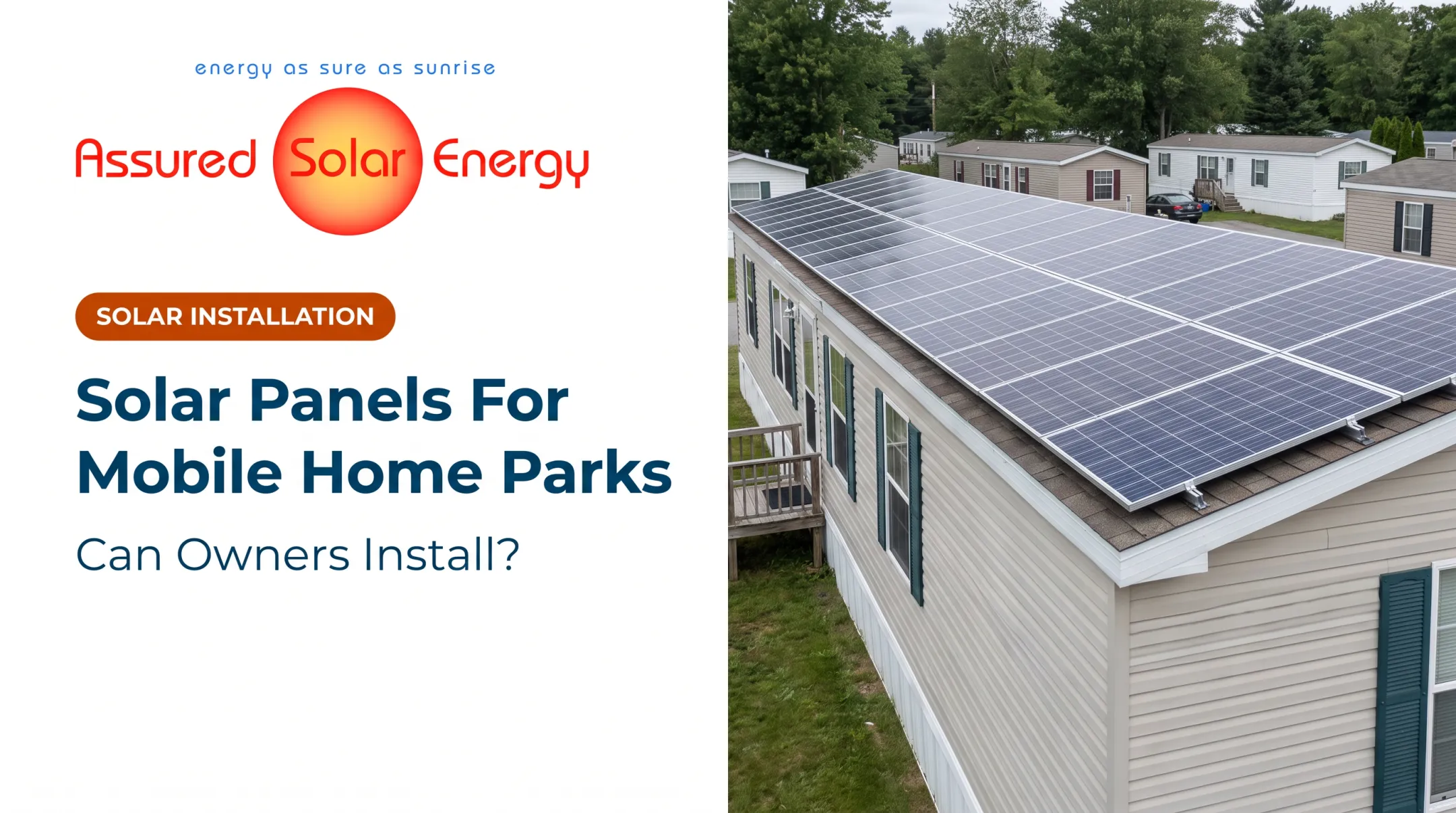
Roof mounting works when the structure can handle added weight, the roofing material is in good condition, shading is minimal, and your community or landlord permits permanent changes.
Assured Solar Energy's SnapNrack racking system, used on projects like a 44-panel, 12.76 kW roof-mounted array in Freeport, Maine, is UL-listed and designed to handle wind and snow loads while protecting the roof underneath. Roof penetrations get properly flashed to prevent leaks and meet building code, a detail that's easy to skip and expensive to fix later.
When Ground Mounting Is the Better Call
Ground mounting suits homes with weak or shaded roofs, or owners who want easier snow clearing and adjustable panel orientation.
One project, a ground-mounted array using 24 panels at 260 watts each, was sized around 6.2 kW with room to expand toward 8 kW, showing how ground systems can grow over time in a way roof arrays often can't. Just budget for trenching, fencing if required, and local setback rules, which vary by town.

Portable Systems Have Limits
Portable panels suit seasonal camps or rented sites where permanent changes aren't allowed. They're rarely enough for whole-home off-grid living, though. Think of them as a stopgap for essential loads, not a full replacement for a sized system.
Whichever mounting method you choose, a qualified solar and electrical professional should handle the installation, especially where the array connects to your home's distribution panel or powers medical equipment and water systems.
What Does an Off-Grid Solar System for a Mobile Home Cost and How Is It Maintained?
Costs swing widely based on daily energy demand, panel capacity, battery chemistry, inverter size, mounting method, and electrical upgrades. Trenching, permitting, labor, and whether a generator is part of the plan also move the total. There's no single number that applies to every mobile home.
When comparing quotes, break costs into categories:
- Panels and racking
- Batteries
- Inverter/charger
- Balance-of-system equipment (wiring, disconnects, monitoring)
- Installation labor and site prep
- Future battery replacement
Portable kits, partial backup systems, and complete professionally installed off-grid systems aren't directly comparable. A $400 portable kit and a fully engineered whole-home system solve very different problems, even though both get called "solar."
Keeping the System Running
Ongoing maintenance isn't complicated, but it matters:
- Inspect panels, wiring, and ground-mount hardware periodically.
- Monitor battery state of charge and system alerts.
- Keep panels clear of avoidable shading or debris buildup.
- Maintain generator readiness if one's part of the design.
- Schedule a professional electrical inspection every few years.

Seasonal conservation habits stretch your system's reliability further. Cut back on electric heating, shift flexible loads like laundry into sunny afternoons, and keep a reserve charge before storms or extended winter cloud cover.
If you own a remote home, camp, cabin, or manufactured home in Maine, Assured Solar Energy offers site-specific assessments covering loads, solar access, storage needs, and mounting options, backed by a 30-year equipment and labor warranty on installed systems.
Frequently Asked Questions
How much would it cost to solar power a mobile home?
Cost depends on your energy use, desired battery autonomy, mounting approach, inverter size, and site work. Compare a complete off-grid installation quote rather than judging by panel prices alone.
How many solar panels do I need to run a mobile home?
Panel count depends on daily kWh use, panel wattage, local sunlight, shading, and how much battery recharging you need. Start with a load calculation before shopping for panels.
How long will a fully charged solar battery last?
Runtime depends on usable battery capacity and the combined wattage of everything running. Continuous loads like refrigeration drain batteries differently than intermittent appliances, and inverter losses reduce the final number.
Can solar panels be put on a mobile home roof?
Sometimes, after a structural, condition, and shading review confirms the roof can handle it. Where the roof isn't suitable, ground-mounted or portable panels are common alternatives.
What are the best solar panels for mobile homes?
The best panel balances efficiency, weight, dimensions, durability, warranty, and compatibility with your available space. Choose it as part of a complete, properly sized system rather than by efficiency rating alone.