
Many homeowners assume their solar panels will keep the lights on during a power outage. They won't, not without a battery and the right backup equipment designed in advance. This guide covers how PV battery storage actually works, where it delivers real value, which battery types fit different budgets, how to size a system, what it costs, and what to ask an installer before you sign anything.
There's no single "right" system here. Whether your goal is backup power during storms, lower grid reliance, higher solar self-consumption, full off-grid independence, or better demand management for a business, the right setup looks different every time.
Key Takeaways
- A solar battery stores excess PV electricity for later use; it doesn't automatically back up your whole home.
- Usable capacity, power output, backed-up circuits, battery chemistry, and inverter compatibility all shape real-world performance.
- The right system depends on your energy use, outage priorities, utility rules, property conditions, and budget.
- Compare complete installed-system proposals and warranty terms, not battery sticker prices alone.
What Is a Solar Battery Storage System and How Does It Work?
A solar battery storage system pairs photovoltaic panels with a battery that captures surplus electricity and releases it when the sun isn't producing enough, after dark, during cloudy stretches, or when the grid goes down. Several components work together to make that happen:
- Solar panels generate DC electricity from sunlight
- Inverter or hybrid inverter converts that DC power into usable AC power
- Battery and battery management system store charge and regulate discharge cycles
- Electrical panel and backup circuits determine exactly what stays powered during an outage
- Monitoring platform tracks production, consumption, and battery status in real time
How Energy Moves Through the System
Solar panels produce DC electricity during daylight hours. The inverter converts it for immediate household use. Any surplus beyond what you're consuming charges the battery instead of flowing out to the grid. At night, during low production, or when the grid fails, the battery discharges to power whatever circuits were designed into the backup plan.

Grid-Tied Isn't the Same as Backup
Standard grid-tied solar shuts off automatically during a power outage. That safety measure prevents panels from backfeeding electricity onto lines utility crews may be repairing.
Adding true backup requires grid-forming equipment that can isolate the home from the grid and power only the circuits you've selected in advance. Off-grid systems skip the utility connection entirely and rely on solar generation plus battery storage alone to run the property.
AC-Coupled vs. DC-Coupled
The two coupling approaches differ mainly in where conversion happens:
- AC-coupled: Converts DC to AC, then back to DC for storage. Often suits retrofits on an existing solar array.
- DC-coupled: Feeds panel output directly to the battery before a single inverter handles AC conversion for the home. More common on new installations.
Two numbers matter most when sizing a battery: energy capacity (kWh), how much electricity it can store, and power output (kW), how much it can deliver at once.
A battery with plenty of kWh but limited kW might run your refrigerator all night, then stall when your air conditioner compressor tries to start. You need both figures to know which appliances will actually run, and for how long.
Benefits and Limitations of Solar Battery Storage
Boosting Self-Consumption and Managing Rates
Without storage, surplus solar gets exported to the grid, often at a lower return than retail electricity rates. A battery lets you use that same electricity at 7 p.m. instead of selling it at noon.
Where utilities charge time-of-use rates, stored power can offset expensive peak pricing, though not every utility bills this way. Some businesses also face demand charges: fees based on their highest usage spike in a 10 to 20 minute window each month. Battery discharge can flatten those peaks.

Backup Power: Only What You Design For
A battery doesn't automatically power your entire house during an outage. It backs up only the circuits you've planned for in advance, such as:
- Refrigeration and freezers
- Lighting and communications equipment
- Heating system controls
- Medical equipment
- Well pumps
- Selected business-critical loads
Battery vs. Fuel Generator
| Dimension | Solar battery | Fuel generator |
|---|---|---|
| Noise | Roughly 50 dBA typical operation | Around 67 dBA at 23 feet, normal load |
| Fuel/emissions | Recharges from solar or grid, no fuel burned during use | Runs on natural gas or propane |
| Maintenance | Sealed lithium units often require little upkeep | Scheduled oil, filter, and spark-plug service |
| Sustained runtime | Limited by stored energy and available sunlight | Designed for extended outages, with fuel on hand |
Where Batteries Fall Short
- Upfront cost remains significant compared to solar-only systems
- Capacity is finite and degrades gradually over years of cycling
- Units need dedicated space, clearances, and temperature management
- Power limits may restrict which appliances can run simultaneously
- Cold climates can affect performance and installation requirements
- Generous net-metering terms can reduce the financial case for storage
Who Benefits Most
- Households in outage-prone areas
- Properties with critical loads like medical equipment or well pumps
- Remote sites with limited or no utility access
- Customers facing poor solar export compensation
- Businesses seeking resilience or demand-charge management
Battery Types and Solar Storage System Configurations
Lithium-Ion vs. Lead-Acid
Most residential installations today use lithium iron phosphate (LFP) batteries. Flooded lead-acid remains common in off-grid setups with tighter budgets.
| Specification | LFP battery example | Flooded lead-acid example |
|---|---|---|
| Usable capacity | 5.0 kWh per unit | Rated in amp-hours, not usable kWh |
| Round-trip efficiency | Around 90% AC | Roughly 80% charge efficiency |
| Maintenance | Sealed, minimal upkeep | Periodic watering and ventilation checks |
| Typical warranty | 15 years or set cycle limit | Often 3 years |
Lead-acid banks also release hydrogen during charging, so manufacturers require active ventilation, something lithium units generally don't need.
Emerging Chemistries
Sodium-ion batteries reached the residential market in limited form in 2025. Solid-state batteries remain mostly in commercial or automotive development.
Neither has widespread US residential availability, installer support, or standard warranty terms yet. Treat them as options to watch rather than proven choices today.
Beyond Chemistry: What Else to Compare
- Usable kWh versus rated kWh
- Continuous and surge kW output
- Depth of discharge and round-trip efficiency
- Operating-temperature range
- Expandability for future capacity
- Monitoring features and warranty terms
Matching a Battery to Existing Solar
Adding storage to a system you already own means checking a few compatibility points first:
- Inverter age and brand compatibility
- System voltage
- Electrical-panel capacity
- Monitoring platform support for the added battery
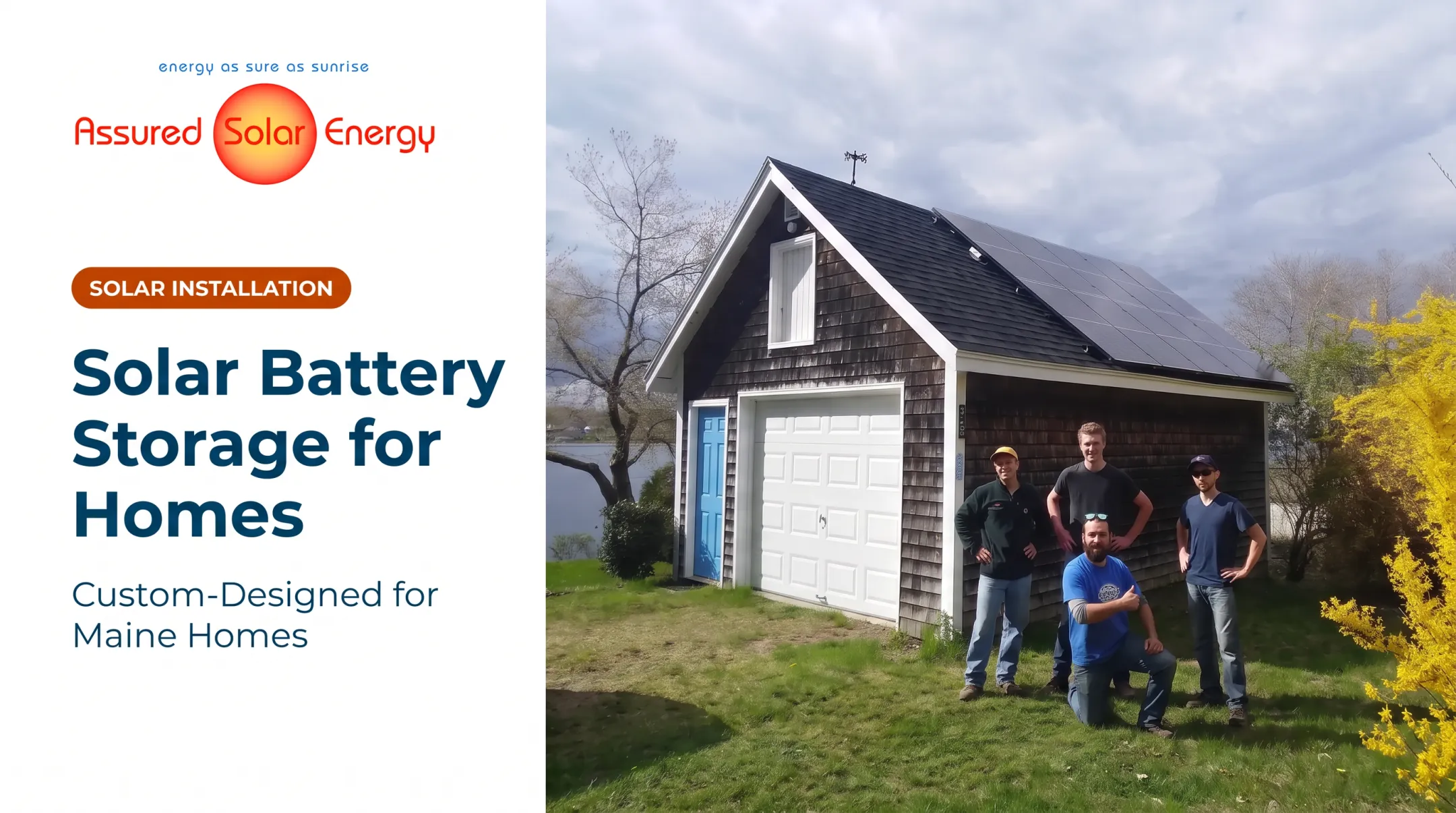
Assured Solar Energy's Seaside Garage System Addition, for example, added battery-backed storage to an existing residential array without a full system rebuild. That retrofit path works when the current inverter can support storage.
How to Size a Solar Battery Storage System
Define the Objective First
Decide what the battery needs to accomplish before you pick a capacity:
- Essential-load backup only (fridge, lighting, communications)
- Partial-home backup for a defined circuit list
- Whole-home backup
- Higher solar self-consumption
- Peak-rate or demand-charge management
- Continuous off-grid operation
Gather the Right Data
Collect these inputs before you size anything:
- 12 months of utility bills or interval data where available
- Nameplate wattage for key appliances
- Planned future loads such as an EV charger, heat pump, or electric water heater
Daily energy use in kWh equals watts multiplied by hours used, divided by 1,000.
The Sizing Relationship
There's no universal "right" battery size. Capacity depends on daily energy use, desired backup duration, budget, and how much sunlight is available to recharge the battery between outage days.
A nationwide modeling study found that a 10 kWh battery paired with solar could cover basic backup loads, excluding heating and cooling, through a three-day outage in nearly every US county.
Add heating and cooling to the critical-load list, and that same 10 kWh battery covers about 86% of critical-load hours on average, compared to 96% for a 30 kWh system, according to Berkeley Lab's modeling study.

Build a Critical-Loads Plan
Identify three categories before sizing anything:
- High-starting-current equipment like well pumps and AC compressors, which draw far more power at startup than during steady operation
- Continuous loads such as refrigeration and medical equipment that run around the clock
- Loads needing management, where a larger inverter or smart load-shedding avoids overloading the battery
A Worked Example
Say your critical loads average 1,200 watts of continuous draw, with spikes to 3,500 watts when a well pump starts. Dividing a 10 kWh usable battery by 1,200 watts suggests roughly 8 hours of runtime.
Real-world runtime is usually shorter. Inverter losses, a reserve setting that preserves some charge, cold weather, and overlapping loads all cut into that number.
Plan for Future Expansion
If an EV or heat pump might join your home later, confirm now whether your inverter, panel capacity, enclosure, and warranty terms support adding battery modules down the line.
Costs, Lifespan, Incentives, and Long-Term Value
What's Included in an Installed Price
A real quote covers more than the battery itself:
- Equipment, inverter, or control hardware
- Electrical work, mounting, or enclosure
- Critical-loads panel, permitting, and design
- Commissioning and monitoring setup
Site access, panel upgrades, and backup scope all move the final number.
Marketplace quotes for battery storage climbed from $999 per kWh in late 2024 to $1,074 per kWh in the second half of 2025, according to EnergySage's marketplace report.

These are marketplace medians, not a quote for your specific roof or backup scope. Get a site-specific installed quote before comparing options.
How Long a Battery Actually Lasts
Warranty terms, cycle limits, and retained-capacity guarantees are three separate measures. Some manufacturers back batteries for 15 years or a set number of discharge cycles, whichever comes first, and guarantee a minimum retained capacity at set milestones.
A warranty period is not a promise of exact service life. Daily cycling, temperature, and usage patterns all affect real-world performance.
Incentives Worth Checking
The federal residential clean energy credit covers 30% of qualifying battery and installation costs for systems placed in service through the end of 2025. Batteries must have at least 3 kWh of capacity, per IRS guidance.
That credit is not available for installations placed in service after that date. State and utility programs vary widely, from performance-based payments to income-qualified rebates, so check current local options and confirm eligibility with a qualified tax professional.
Long-Term Value Isn't Just Payback
Weigh avoided electricity purchases against expected degradation, eventual replacement costs, financing, and how much you personally value resilience during outages. A simple payback calculation misses the backup-power value entirely for households in storm-prone areas.
How to Choose an Installer and Plan the Installation
Questions to Ask Before You Sign
- Which specific loads will be backed up, and which circuits are excluded?
- What is the usable capacity, not just the rated capacity?
- What are the continuous and surge power ratings?
- Which equipment is covered under warranty, and for how long?
- Who handles permitting, interconnection, commissioning, and future service calls?
What a Site Assessment Should Cover
- Roof or array condition and solar production potential
- Electrical-panel capacity for added equipment
- Battery placement, clearances, and ventilation
- Flood or weather exposure at the installation site
- Local code and permitting requirements
What a Proper Proposal Should Show
A professional proposal lays out system architecture, expected energy flows, backup circuits, operating modes, equipment specifications, warranty terms, monitoring access, and the assumptions behind any savings estimate. If a proposal skips these details, ask why.
Assured Solar Energy, a Maine-owned design-and-installation company founded in 2006, works with residential, commercial, and agricultural customers across Midcoast and Southern Maine on both grid-tied and off-grid systems, including island and remote-site projects. The company uses LIDAR-based design to map roof and site conditions before proposing a system, and backs installations with a 30-year equipment and labor warranty.
Frequently Asked Questions
What is a PV battery storage system?
It's equipment that stores electricity generated by solar panels for use later, whether that's after sunset or during a grid outage. The inverter and energy-management controls determine how and when that stored power gets used.
How much does it cost to add battery storage to a solar system?
Pricing depends on capacity, power rating, equipment brand, retrofit complexity, electrical work, permits, and local incentives. Request a site-specific installed quote rather than relying on a general price range.
How long can solar power be stored in a battery?
Stored energy can generally be held until needed, but usable runtime depends on reserve settings, self-discharge, connected loads, system efficiency, and how much time remains for solar recharging.
How long does a PV battery last?
Expect a manufacturer warranty tied to years or discharge cycles, often with a minimum retained-capacity guarantee at specific milestones. Actual lifespan varies with usage patterns, temperature, and maintenance.
Is a 10kW battery enough to run a house?
That figure likely describes power output (kW), not energy capacity (kWh), so it doesn't tell you runtime on its own. Adequacy depends on appliance demand, surge loads, which circuits are backed up, and how long you need power to last.
What is the best solar and battery system for my home?
It depends on your energy goals, consumption patterns, existing solar equipment, utility rules, budget, and backup priorities. A professional load and site assessment is the only reliable way to answer that question.