
That single distinction drives nearly every other decision: how much equipment you need, what the system costs upfront, whether you have power during a blackout, and how much day-to-day attention your batteries require.
Battery storage is becoming a bigger part of this conversation nationally. Storage accompanied 37% of new residential solar installations in 2025, up from 25% the year before, according to Berkeley Lab's 2026 update. That's a storage-attachment trend, not an off-grid adoption rate, but it shows battery-backed systems are no longer a niche choice.
The right setup depends on whether you have utility access, how much electricity you use, your budget, and how badly you want backup power. We'll walk through both options so you can figure out which one fits your property.
Key Takeaways
- On-grid solar stays connected to the utility and can export surplus power; off-grid solar runs entirely on battery storage.
- Less equipment and lower upfront cost favor on-grid systems, but standard setups shut down during outages.
- Off-grid systems suit remote homes, camps, cabins, and islands where utility hookup isn't practical or affordable.
- Location, energy use, backup needs, utility rules, and long-term budget priorities determine which system fits.
Off-Grid vs. On-Grid Solar: Quick Comparison
Here's how the two approaches compare on the factors that matter most:
| Factor | Off-Grid | On-Grid |
|---|---|---|
| Utility connection | None | Connected, can draw or export |
| Batteries | Required | Optional (needed for backup) |
| Power during outages | Yes, if sized correctly | No, unless battery-backed |
| Upfront equipment | More complex | Simpler |
| Export credits | Not applicable | Net metering/billing available |
Utility Connection
An off-grid property has no physical tie to the public utility network. It has to meet 100% of its own electricity needs, every day, year-round.
An on-grid (grid-tied) system stays wired to the utility. The solar array covers what it can, and the grid fills in the gaps when production dips or demand spikes.
Battery and Backup Requirements
Off-grid systems treat batteries as non-negotiable. Without stored energy, there's no power at night or during stretches of heavy cloud cover. A backup generator or extra storage capacity can help bridge unusually long low-sun periods.
Standard grid-tied systems don't need batteries at all. The utility acts as the backup. If you want power during an outage, though, you'll need a battery sized and configured specifically for that purpose, not just panels on the roof.
Power During Outages
This is where a lot of homeowners get surprised. A standard grid-tied system goes dark the moment the grid does, even on a sunny afternoon.
That's by design. Grid-tied inverters include anti-islanding protection, which detects a utility outage and halts power production within about 2 seconds, per NREL's 1547 summary. It exists so repair crews don't get electrocuted by power flowing backward into supposedly dead lines.

Off-grid systems don't have this problem because they were never tied to the grid in the first place. As long as the array, batteries, and inverter are properly sized and functioning, they keep running through an outage.
Cost and Ongoing Maintenance
Off-grid systems generally cost more to build because they require:
- A battery bank sized for your critical season, not just an average month
- A charge controller to manage battery charging
- An island-capable inverter
- Possibly a backup generator for extended low-sun stretches
On-grid systems need less hardware upfront, but don't assume they're maintenance-free forever. Interconnection fees, permitting costs, and eventual inverter or battery replacement still factor into the long-term bill.
Financial and Operational Trade-offs
Grid-tied customers may benefit from net metering or net billing, where exported electricity earns credit against future bills. Maine's Net Energy Billing program, for example, credits solar exports at a straight one-kWh-to-one-kWh ratio. Other states handle it differently, so check your utility's actual tariff before assuming a rate.
Off-grid owners skip utility rate hikes and export programs entirely, but they carry full responsibility for system capacity, storage management, and eventual equipment replacement. There's no utility safety net to fall back on.
What Is an Off-Grid Solar System?
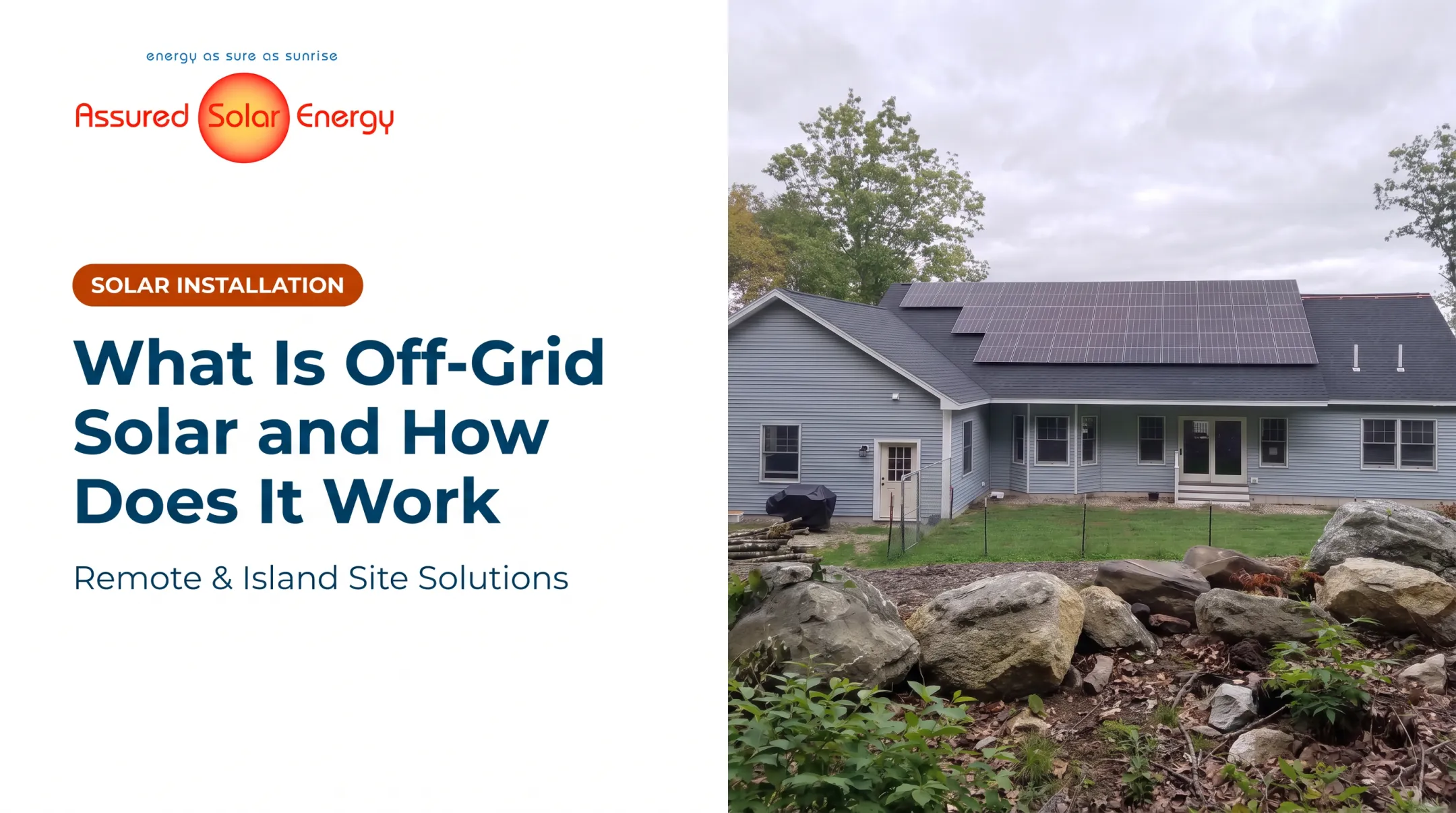
An off-grid solar system is a standalone setup, physically disconnected from the public utility, that produces, stores, and converts every kilowatt-hour a property uses.
How the components work together:
- Solar panels generate DC electricity from sunlight
- A charge controller regulates how that electricity charges the battery bank
- Batteries store energy for use at night or during low production
- An inverter converts stored DC power into usable AC electricity for the building
Sizing Starts With Load, Not Panel Count
A common mistake is sizing an off-grid system by panel count alone. That's backwards. Proper design starts with an energy-load assessment covering:

- Daily electricity use in kWh
- Peak demand and which appliances might run at once
- Starting loads for motors, pumps, or compressors
- Seasonal changes in both consumption and sunlight
- Desired days of battery autonomy during bad weather
Seasonal Swings Matter More Than Annual Averages
Winter in Maine is brutal on solar production. Portland-area resource data used in local system modeling shows roughly 5.5 kWh/m²/day in July dropping to around 3 kWh/m²/day in December, with storms and snow cover cutting it further.
Sizing against an annual average invites a system that runs out of power exactly when you need it most. The critical design month, not the sunniest one, should drive battery and array sizing.
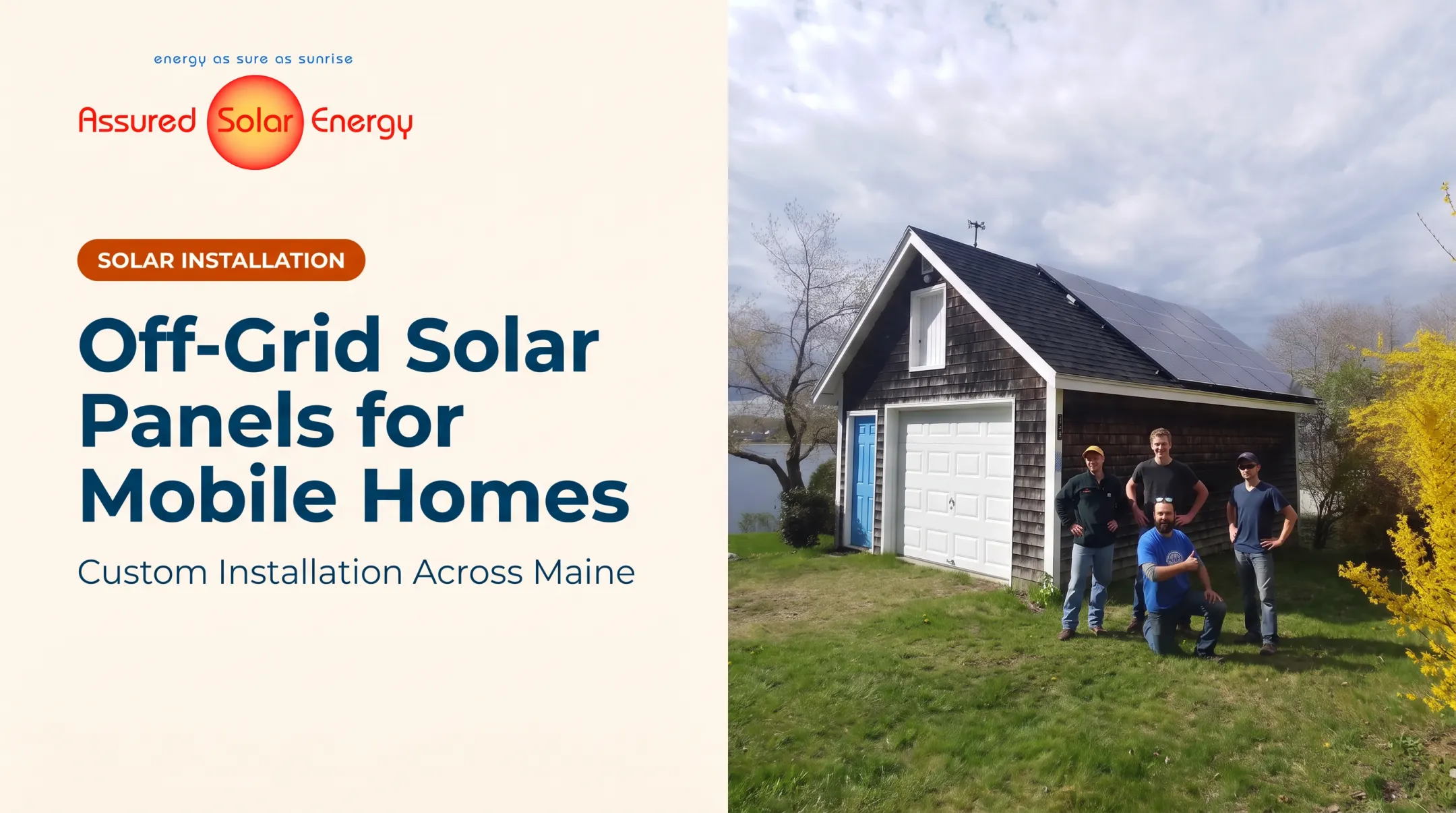
Off-grid solar makes sense for remote homes, hunting camps, island properties, and agricultural sites where running utility lines would be impractical or prohibitively expensive. Assured Solar Energy has designed and installed these systems for homes and camps across Maine, including island communities in Casco Bay.
Off-grid doesn't automatically mean cheaper or maintenance-free over the system's lifetime. Expect different trade-offs around cost, upkeep, and reliability.
What Is an On-Grid Solar System?
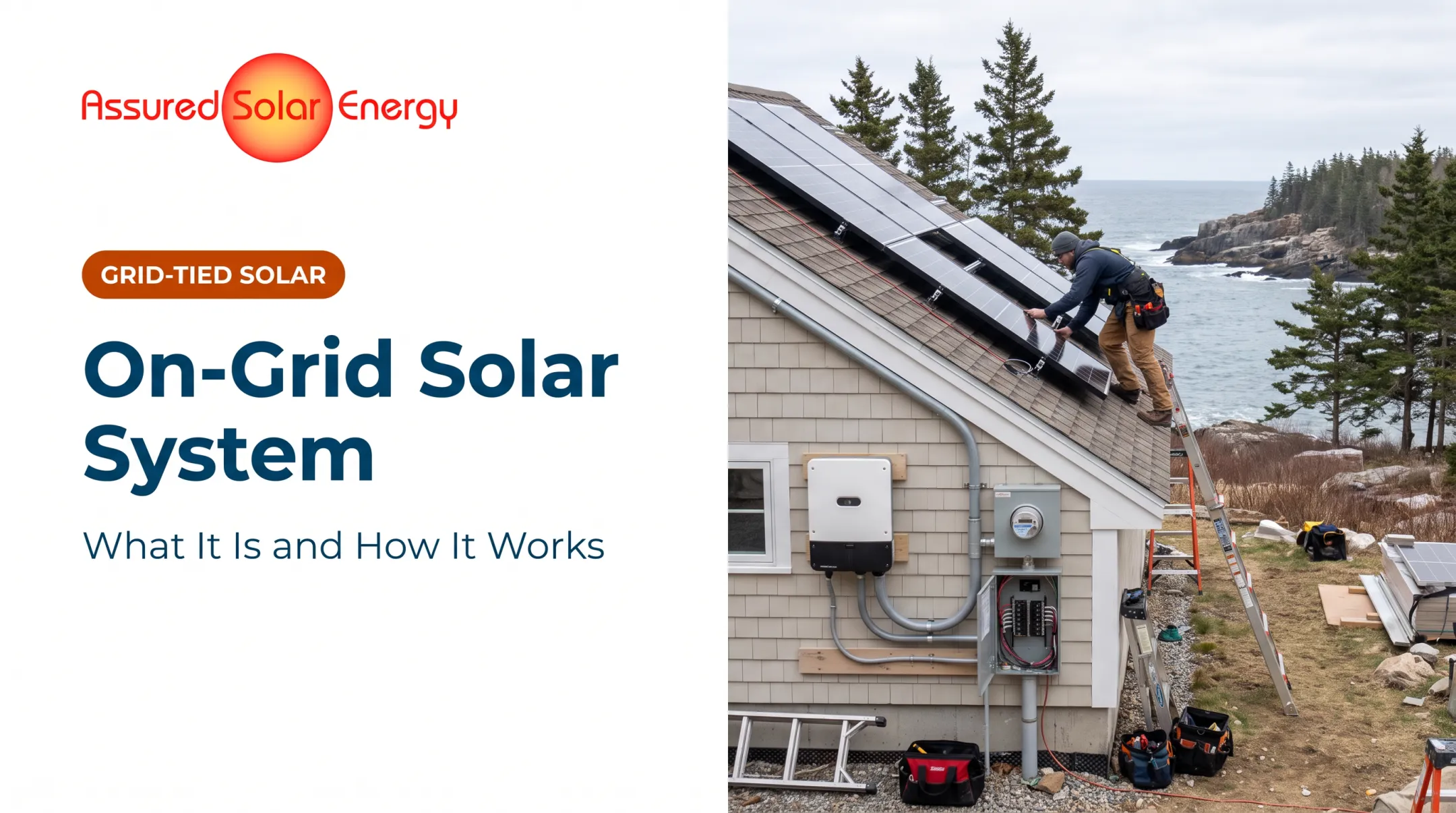
An on-grid (or grid-tied) solar system works in parallel with your local utility rather than replacing it.
The energy flow works like this:
- Panels generate electricity during daylight hours
- An inverter converts it into usable AC power for the building
- The property pulls from the grid whenever solar production falls short
- Excess production can be exported to the utility under the applicable program
Why Homeowners Choose Grid-Tied
On-grid systems have real advantages for most properties with utility access:
- Access to utility power whenever solar production dips, no battery required
- Fewer components means simpler installation and lower upfront equipment cost
- Minimal daily energy management, no manual load-shifting needed
- Potential to cut electricity purchases significantly over time
One Maine residential example cut monthly electric charges by roughly 92%, with winter bills dropping from around $322 to under $85 after installation.
Net Metering Rules Vary by State
Those savings hinge on how your utility credits exported power. Export compensation isn't standardized nationally. Some states use straight net metering, where exported kWh offset future usage one-for-one. Others use net billing, where exports get a separately priced credit, often below the retail rate.
Fixed charges, interconnection requirements, and eligibility caps also differ by utility. Check your specific provider's current tariff rather than assuming your neighbor's deal applies to you.
The Catch: No Power During Outages
Here's the limitation that trips up a lot of buyers. A conventional grid-tied system, to meet UL 1741 safety standards, shuts down automatically when the grid goes down. This happens even on a bright, sunny day.
Getting backup power during an outage requires a battery sized and wired specifically for that job, not just a standard grid-tied array.
Off-Grid vs. On-Grid: Which Is Better for Your Property?
There's no universal winner here. The right answer depends on:
- Whether utility access is available or even nearby
- How the property is used (year-round home vs. seasonal camp)
- Daily and peak energy consumption
- How often outages happen in your area
- Budget for upfront equipment versus long-term independence
- Available roof or ground space
- Comfort level managing batteries and loads yourself
Choose on-grid when: your property has reliable utility access, your main goal is cutting electricity bills, and you want a simpler system without full energy independence.
Choose off-grid when: utility connection isn't practical or available, and you're prepared to take on the cost and responsibility of generating and storing all your own power.
Consider a battery-backed hybrid when: your goal is outage resilience, not complete separation from the grid. A hybrid stays connected day-to-day but can island during an outage, which is a distinct setup from going fully off-grid.
Three Real-World Scenarios
- A remote seasonal camp with no utility access needs a sized off-grid system with battery autonomy for multi-day cloudy stretches.
- A typical grid-connected home, such as Assured Solar’s 12.76 kW Freeport, Maine array, usually works best as a standard grid-tied system.
- A small business wanting lower bills plus outage protection fits grid-tied solar with battery backup to cut costs and keep critical equipment online.

Not sure which path fits your property? Assured Solar Energy has designed and installed both grid-tied and off-grid systems across Maine since 2006, including remote and island sites.
LIDAR-based design maps what your roof or land can support. A professional assessment beats guessing.
Conclusion
On-grid solar suits properties with reliable utility access where the goal is lower bills and a straightforward installation. Off-grid solar is built for properties and owners who want complete independence and are willing to manage the equipment and responsibility that comes with it.
Either way, accurate system design has to account for more than how many panels fit on the roof. Site conditions, electrical loads, seasonal production swings, battery capacity, and future energy needs all shape the right system. When comparing proposals, look past panel count and focus on system design quality and long-term support.
Frequently Asked Questions
What are the key differences between on-grid and off-grid solar power?
On-grid systems stay connected to the utility, can export surplus power, and shut down during outages unless battery-backed. Off-grid systems run entirely on stored battery power and operate independently of the utility at all times.
Which type of solar system is better, on-grid, off-grid, or hybrid?
It depends on your utility access, budget, and backup needs. On-grid suits properties focused on bill reduction, off-grid suits remote sites, and hybrid adds outage resilience without going fully independent from the grid.
Can you go completely off-grid with solar and battery?
Yes, if the system is properly sized for your loads and your area's seasonal sunlight. This often requires substantial battery storage, careful energy management, and sometimes a backup generator for extended low-sun periods.
How do you calculate a hybrid solar system?
Start with a load analysis covering daily kWh use, peak demand, and desired backup duration, then match that against expected solar production and battery capacity. A qualified installer should review the final design before installation.
Is 10 kW enough to run a house?
It depends. Ten kW describes a system's output capacity, not your total energy needs. US households average around 863 kWh per month, according to EIA's 2024 data, but actual needs vary with sunlight, storage, heating equipment, and season.
Is it possible to convert on-grid solar to hybrid?
Often, yes. Conversion typically requires compatible batteries, a hybrid-capable inverter, some electrical changes, and new permits. A professional evaluation of your existing equipment is the right first step.