
The property, energy demand, equipment selection, and project timeline look very different depending on whether you're powering a house or a warehouse. Get these assumptions wrong and it can throw off system sizing, roof planning, engineering requirements, financing, and the incentives you qualify for.
Assured Solar Energy has designed and installed systems for homeowners, farms, and businesses across Maine since 2006. This guide breaks down how panel design, system scale, costs, warranties, and installation complexity differ between residential and commercial solar, and what should actually drive your decision.
Key Takeaways
- Residential solar sizes to household use, roof space, and backup; commercial sizes to loads and financial goals
- Panel size alone doesn't determine whether a system is "commercial" or "residential"
- Commercial projects typically involve more engineering, utility coordination, and permitting
- Compare total system value (warranties, financing, tax eligibility), not just panel price
- Roof condition, ownership structure, and future energy needs matter as much as the building type
Commercial vs Residential Solar Panels: Quick Comparison
Panel and System Scale
Module wattage varies by manufacturer and product line, not strictly by property type. REC's residential-oriented Alpha Pure-RX panel runs 450-470 watts, while Qcells' larger Q.TRON XL-G2, commonly used in commercial rooftop applications, reaches 620-645 watts, according to REC's product datasheet.
System size tells a similar story. The U.S. Department of Energy models an 8 kW home system against a 250 kW school rooftop, and the gap gets even wider on the commercial side with ground-mounted arrays reaching into the megawatts.
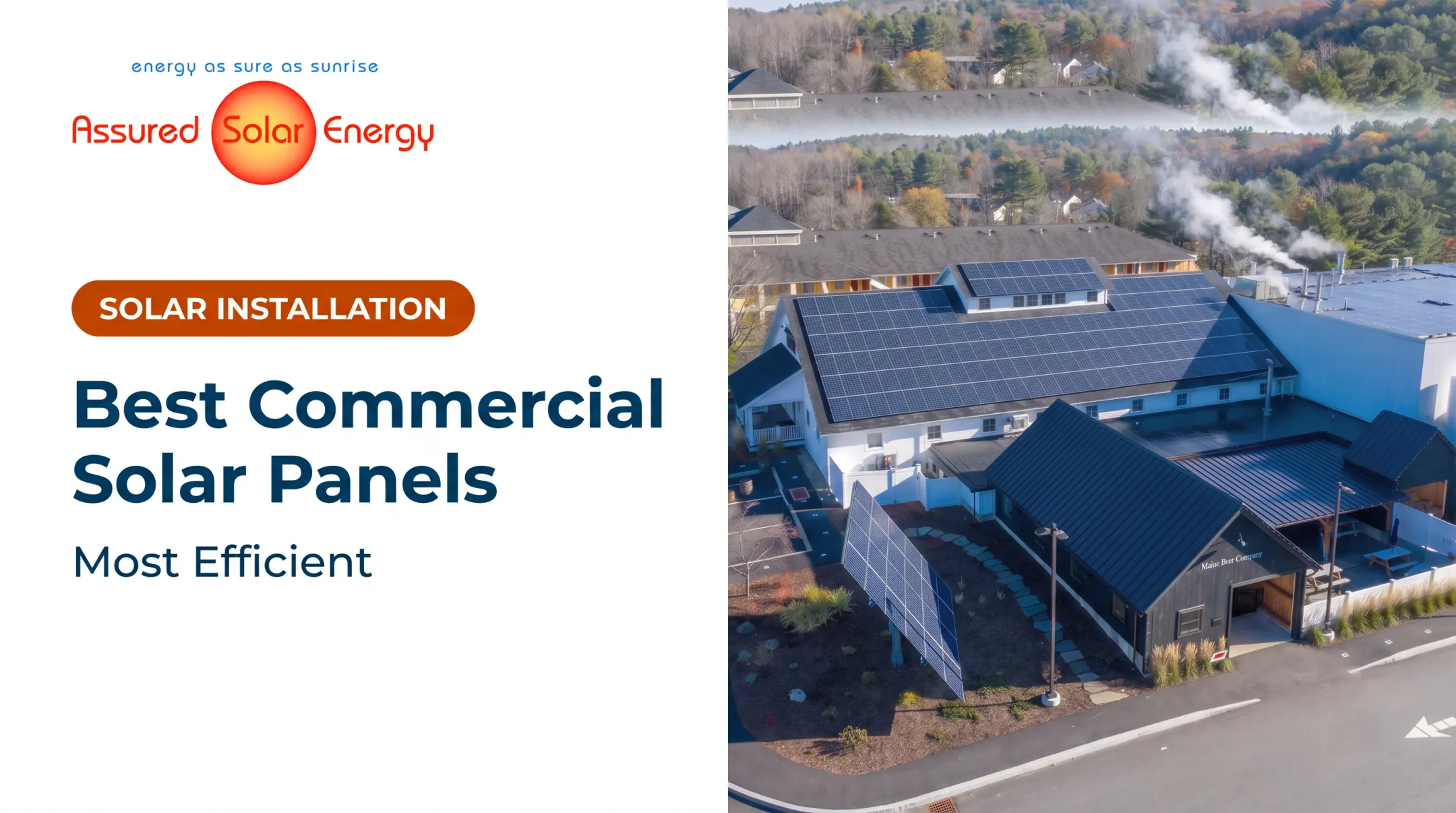
In Assured Solar's own project history, residential arrays have ranged from a 3.48 kW addition using 12 panels to a 13.9 kW system using 48 panels on a single Freeport, Maine home. Commercial sites, like the Maine Beer Company facility, use multiple rooftop arrays plus a ground-mounted system to match a much larger daytime load.
Installation Location and Appearance
Residential installs usually work with:
- Sloped asphalt shingle or metal roofs
- Low-profile, roof-following mounting
- All-black modules for visual integration
- Shading, setbacks, and roofline aesthetics as real design constraints
Commercial sites bring a different set of priorities. Flat roofs call for ballasted or attached racking systems designed around wind load and roof structure, and many businesses have enough land or parking area to consider ground mounts or solar carports instead. Production, access for maintenance, and structural loading tend to outweigh appearance.
Electrical Design and Technical Complexity
A residential system generally has one job: match household usage to available roof space and existing electrical service. The interconnection process is comparatively straightforward.
Commercial projects carry more moving parts. Depending on size, they may require:
- Structural engineering review for roof-mounted arrays
- Larger switchgear and protective equipment
- Transformer or electrical service upgrades
- Demand-charge analysis, since the Department of Energy notes that solar alone has limited ability to reduce demand charges on its own
- Multiple meters and more detailed utility plan review
Assured Solar's commercial process folds these steps into design, engineering, permitting, procurement, installation, and activation, rather than leaving a business to coordinate each piece separately.
Cost and Financing
Pricing scales with the project, but not in a straight line. The Department of Energy's 2025 modeled market pricing puts residential PV at roughly $2.95 per watt, compared with about $1.98 per watt for commercial systems, largely due to fixed costs spreading across more watts, according to DOE's cost benchmarks.

For homeowners, that typically translates to installed costs in the neighborhood of $20,000, give or take about $10,000 depending on roof complexity, system size, and whether storage is included.
Commercial projects involve a larger total investment even when the per-watt cost is lower, and the financing path looks different too:
- Cash purchase: full ownership from day one
- Commercial loan: ownership with financed payments
- Solar lease: paying to use equipment owned by a lessor
- Power purchase agreement (PPA): buying the electricity a third-party-owned system produces
Warranties, Service Life, and Performance
Not every commercial panel has a shorter warranty than every residential panel; it depends on the specific product. Manufacturer warranties typically separate into three categories:
- Product warranty: covers defects in materials and workmanship, commonly 12-25 years depending on the brand
- Performance warranty: guarantees a minimum output over time, often 25-30 years, with annual degradation usually between 0.25% and 0.7%
- Inverter warranty: covered separately from the panels, often shorter unless extended
Assured Solar backs its installations with a 30-year equipment and labor warranty, covering both the hardware and the installation work across residential and commercial projects alike.
What Are Residential and Commercial Solar Panels?
Residential Solar Panels
Residential solar is a photovoltaic system built for a home, typically a rooftop array paired with a grid connection and, increasingly, a battery or EV charger.
The appeal for homeowners comes down to a few things:
- Lower utility bills through grid credits on excess production
- Backup power during outages when paired with storage
- Efficient use of existing roof space
- Design that blends with the home's appearance rather than standing out
Design decisions hinge on annual electricity use, roof orientation and shading, roof age, snow load, available electrical panel capacity, and whether the homeowner plans to electrify more of the house (think heat pumps or an EV) down the road.
Assured Solar Energy's residential process starts with a consultation, moves into a custom design built with LIDAR technology, and finishes with installation that includes proper roof flashing and wire management.

Commercial Solar Panels
Commercial solar covers businesses, agricultural buildings, institutions, and multifamily properties, sized around the site's actual operating loads rather than a standard household profile.
The benefits are primarily financial and operational:
- Controlling or reducing operating costs
- Offsetting daytime loads when a business uses the most power
- Supporting sustainability commitments
- Managing demand charges where feasible
- Building resilience into long-term property or business planning
Commercial projects also carry more variables to evaluate: roof condition and remaining life, structural capacity, seasonal load profiles, utility interconnection requirements, and whether a landlord or tenant needs to sign off.
For agricultural and larger facilities, land availability and keeping operations running during construction matter too.
Same Technology, Different Scale
Modules, inverters, racking, monitoring, and optional batteries show up in both residential and commercial projects. The real differences come from scale, site constraints, ownership structure, and financial treatment, not the underlying hardware.
Assured Solar Energy supports residential, commercial, agricultural, grid-tied, off-grid, battery-backup, EV-charging, and remote-site projects. Rather than assuming a panel category before looking at the property, a site assessment is usually the better starting point.
Commercial vs Residential Solar: Which Is Better for Your Property?
Neither category is universally "better." The right design depends on the property type, load profile, available space, ownership structure, and local utility requirements.
Go residential-oriented when:
- The project is for a home
- Rooftop integration and appearance matter
- The goal is household bill reduction or backup for essential circuits
- You want a predictable, well-defined installation scope
Go commercial-oriented when:
- The project serves a business, farm, multifamily property, or institution
- Daytime energy consumption is substantial
- There's usable roof or land to work with
- The project needs detailed financial and engineering analysis
Equipment choice doesn't always follow the label. A small business might use panels typically seen on homes if that's what fits the roof and budget; a large home might use higher-capacity equipment to cover an all-electric household.
The installer should base the decision on code compliance, structural fit, warranty terms, and total installed value, not category assumptions.
A Practical Pre-Proposal Checklist
Before comparing quotes, gather:
- Six to twelve months of utility bills or usage history from your provider
- Ownership and roof details – who owns the property, and the roof's age and condition
- Structural and electrical conditions – panel capacity, service size, any known limitations
- Storage and EV-charging goals – current needs and anything planned in the next few years
- Future load changes – electrification plans, business expansion, added equipment
- Tax and incentive eligibility – confirm current federal and state programs apply to your project
For commercial customers, Assured Solar Energy's process can include design, engineering, permitting, procurement, installation, activation, and compliance support, along with guidance on tax-credit timing. That depth of process reflects how many moving parts a commercial project actually has, not a guaranteed dollar outcome.
Real-World Applications and Project Examples
Residential: A Freeport, Maine homeowner worked with Assured Solar to design a 12.76 kW rooftop array using REC 290-watt panels, balancing budget, appearance, and production goals. The SnapNRack mounting system was chosen specifically to handle Maine's wind and snow loads without compromising the roofline.
A separate coastal project added a 10-panel garage system with saltwater-resistant panels and battery backup, giving the homeowner both expanded capacity and outage protection.
Agricultural: USDA Rural Development's FY2024 report documents a 66.6 kW solar array proposed for a grain-production operation in Iowa, backed by a $75,555 grant. USDA projected the system would replace 88,200 kWh annually, equal to 100% of the farm's prior electricity usage, according to USDA's REAP report.

These are projected figures rather than measured results. They show why farm systems get sized against actual consumption data instead of a generic commercial template.
The same contrast shows up in both cases:
- Residential projects prioritize fit, appearance, and household needs
- Commercial and agricultural projects lean harder on engineering and financial modeling
If you're weighing options for your own property, a property-specific assessment from Assured Solar Energy is a reasonable next step.
Conclusion
Commercial and residential solar panels are built for different properties and energy loads. The right choice depends on the site, demand, roof or land conditions, electrical infrastructure, and the financial goals behind the project.
The clearest path forward is comparing complete system proposals, not just panel specs, and checking current incentives before committing. Assured Solar Energy designs and installs residential, commercial, and agricultural systems across Maine, including grid-tied, off-grid, battery, and EV-charging projects. Call 207-221-2916 to talk through what fits your property.
Frequently Asked Questions
What is the difference between commercial and residential solar panels?
The differences usually come down to project scale, mounting method, electrical design, permitting requirements, and financing rather than the panels alone. Exact specifications vary by project and installer.
Can residential solar panels be used for commercial applications?
Sometimes, yes. It depends on available space, power requirements, code compliance, warranty terms, roof type, and the total installed cost compared to commercial-specific equipment.
Is the 30% solar tax credit going away in 2026?
Residential credits under Section 25D end for expenditures after December 31, 2025, per IRS guidance. Commercial eligibility follows separate construction and service deadlines, so confirm details with a tax professional.
How many years do commercial solar panels last?
Panels commonly operate for 30-35 years, but product warranties, performance warranties, and inverter coverage are separate terms with different lengths. Verify specifics using current manufacturer documentation.
Are commercial solar panels more efficient than residential panels?
Not inherently. Efficiency depends on the specific module, cell technology, orientation, temperature, and shading, not whether a project is labeled commercial or residential.
Which type of solar panel is right for my property?
That depends on your property type, electricity use, roof or land conditions, structural and electrical capacity, aesthetics, storage goals, and budget. A professional site assessment is the most reliable way to answer that question.